BERT:Encoder-Only 预训练
前几节实现的 GPT 是 Decoder-Only 结构,靠 causal mask 让每个 token 只能看到前面的内容。Transformer 论文里还有另一个结构——Encoder,它不做 mask,每个 token 可以看到整句话的全部位置。
这一节实现一个 Encoder-Only 模型 MiniBERT。去掉 causal mask 后,token 的视野从单向变成双向,预训练任务也从预测下一个词变成根据上下文填空——MLM。
一句话里遮掉一个词,让人猜被遮住的是什么。比如「我 [MASK] 你」——只给三个字,中文母语者大概也能猜到 [MASK] 是什么。BERT 学做的就是这件事。
GPT 的训练围绕生成:逐个 token 往后写,写的时候不知道后面是什么。BERT 反过来——不生成,先读完整句话,再回答关于这句话的问题。感情色彩是正面还是负面、文中有哪些地名、两句话是否矛盾——对这些任务,先读完再判断比逐词猜更直接。
1. Encoder 与 Decoder
单向和双向的区别,用一句话就能说清楚。给定句子「我把苹果吃了」,causal mask 下模型看到「我把」时完全不知道后面是「苹果」还是「手机」——只能猜。双向 Attention 下,模型同时看到「我」「把」「苹果」「吃了」——每个词都能参考整句话的所有位置,所以它知道「苹果」是宾语而不是主语。
这个区别决定了模型适合做什么。GPT 适合生成——每次只能看到已经写出来的部分,写完一个词才能看下一个。BERT 适合理解——先通读全文,再回答关于这篇文章的任何问题。
在深入 BERT 之前,需要先明确 Encoder 和 Decoder 在 Attention 上的根本差异:
        Encoder-Only (BERT)          Decoder-Only (GPT)
        ────────────────             ────────────────

        输出: "B-PER"                   输出: "法"
          ↑                               ↑
    ┌─────┴─────┐                   ┌─────┴─────┐
    │  FFN + LN  │                   │  FFN + LN  │
    ├───────────┤                   ├───────────┤
    │ Attention │                   │ Attention │
    │ (双向! )  │                   │ (单向! )  │
    ├───────────┤                   ├───────────┤
    │  Input     │                   │  Input     │
    └───────────┘                   └───────────┘

   每个词能看到所有词              每个词只能看到前面的词
   (包括前面和后面)              (因果掩码)
同一个词「苹果」,在两种 Attention
2. BERT 的输入表示
BERT 的输入不是简单的一个 Embedding,而是三个 Embedding 相加:
输入 = Token Embedding + Segment Embedding + Position Embedding
         ↑                    ↑                    ↑
   "这个词本身是谁"    "属于句子A还是句子B"   "在哪个位置"
这和 GPT 的区别在哪?GPT 只有 Token + Position,不需要 Segment(因为 GPT 不处理"两个句子之间的关系")。
为什么 BERT 需要 Segment Embedding? 因为 NSP(下一句预测)任务需要判断两个句子的关系。
下面用代码展示 BERT 的「完整输入构造过程」:
# ============================================================
# 手动构造 BERT 的输入(从零开始,一步步展示)
# ============================================================

# 模拟一个小 BERT 的配置
import torch
import torch.nn as nn
torch.manual_seed(42)
VOCAB_SIZE = 100
D_MODEL = 16
MAX_LEN = 20
NUM_SEGMENTS = 2  # 句子 A 或 句子 B

# 三个 Embedding
token_embed = nn.Embedding(VOCAB_SIZE, D_MODEL)
segment_embed = nn.Embedding(NUM_SEGMENTS, D_MODEL)
position_embed = nn.Embedding(MAX_LEN, D_MODEL)

# 模拟输入:两个句子
#   [CLS] 我 喜欢 猫 [SEP] 他 喜欢 狗 [SEP]
#   其中 [CLS]=1, [SEP]=2

sentence_A = [1, 5, 8, 3, 2]    # [CLS] 我 喜欢 猫 [SEP]
sentence_B = [6, 8, 4, 2]        # 他 喜欢 狗 [SEP]
full_ids = sentence_A + sentence_B
seq_len = len(full_ids)

print("Step 1: Token IDs")
print(f"  Input: {full_ids}")
print(f"  含义: [CLS] 我 喜欢 猫 [SEP] 他 喜欢 狗 [SEP]")

# Segment IDs:句子 A 的 token 标 0,句子 B 的 token 标 1
segment_ids = [0] * len(sentence_A) + [1] * len(sentence_B)
print(f"\nStep 2: Segment IDs")
print(f"  Segments: {segment_ids}")
print(f"  含义: 前 {len(sentence_A)} 个属于句子A(0),后 {len(sentence_B)} 个属于句子B(1)")

# Position IDs:0, 1, 2, ..., seq_len-1
position_ids = list(range(seq_len))
print(f"\nStep 3: Position IDs")
print(f"  Positions: {position_ids}")

# ============================================================
# 三个 Embedding 相加
# ============================================================
tokens_t = torch.tensor(full_ids)
segments_t = torch.tensor(segment_ids)
positions_t = torch.tensor(position_ids)

tok_emb = token_embed(tokens_t)    # (seq_len, D_MODEL)
seg_emb = segment_embed(segments_t)  # (seq_len, D_MODEL)
pos_emb = position_embed(positions_t)  # (seq_len, D_MODEL)

input_embeddings = tok_emb + seg_emb + pos_emb

print(f"\nStep 4: 三个 Embedding 相加")
print(f"  Token Embedding shape:    {tok_emb.shape}")
print(f"  Segment Embedding shape:  {seg_emb.shape}")
print(f"  Position Embedding shape: {pos_emb.shape}")
print(f"  相加后: {input_embeddings.shape}")

# 展示:同一个词("喜欢",id=8)在两个句子中的 embedding 不同
# "喜欢" 在句子 A 的位置 2,在句子 B 的位置 1
idx_a = 2  # 句子 A 中的 "喜欢"
idx_b = len(sentence_A) + 1  # 句子 B 中的 "喜欢"

print(f"\n★ 关键证明:同一个词在不同位置 + 不同句子的 embedding 不同")
print(f"  '喜欢' 在句子A (pos={idx_a}, seg=0) 的最终 embedding (前 6 维):")
print(f"    {input_embeddings[idx_a, :6].detach()}")
print(f"  '喜欢' 在句子B (pos={idx_b}, seg=1) 的最终 embedding (前 6 维):")
print(f"    {input_embeddings[idx_b, :6].detach()}")
print(f"  它们一样吗? {(input_embeddings[idx_a] == input_embeddings[idx_b]).all().item()}")
print(f"  → 即使词相同,但因为位置和 segment 不同,最终 embedding 也不同!")
Step 1: Token IDs
  Input: [1, 5, 8, 3, 2, 6, 8, 4, 2]
  含义: [CLS] 我 喜欢 猫 [SEP] 他 喜欢 狗 [SEP]

Step 2: Segment IDs
  Segments: [0, 0, 0, 0, 0, 1, 1, 1, 1]
  含义: 前 5 个属于句子A(0),后 4 个属于句子B(1)

Step 3: Position IDs
  Positions: [0, 1, 2, 3, 4, 5, 6, 7, 8]

Step 4: 三个 Embedding 相加
  Token Embedding shape:    torch.Size([9, 16])
  Segment Embedding shape:  torch.Size([9, 16])
  Position Embedding shape: torch.Size([9, 16])
  相加后: torch.Size([9, 16])

★ 关键证明:同一个词在不同位置 + 不同句子的 embedding 不同
  '喜欢' 在句子A (pos=2, seg=0) 的最终 embedding (前 6 维):
    tensor([ 1.7462,  1.3668, -1.6681, -0.8311, -0.6420,  3.6566])
  '喜欢' 在句子B (pos=6, seg=1) 的最终 embedding (前 6 维):
    tensor([ 1.8207, -0.1974, -1.4914,  0.9783, -1.8119,  1.2722])
  它们一样吗? False
  → 即使词相同,但因为位置和 segment 不同,最终 embedding 也不同!
3. MLM 预训练
GPT 的训练任务是「给定前面的词,预测下一个词」(自回归)。 BERT 的训练任务是「遮住中间的某些词,让模型猜它们是什么」(MLM)。
GPT 的训练:  我 → 爱 → 你 → 中国
            只能看 → 方向

BERT 的训练: 我 [MASK] 你 中国  →  猜 [MASK] 是 "爱"
            看左边   看右边
BERT 能同时看到左右两边——因为它的 attention 是双向的(没有因果掩码)。 这使它擅长「理解」,但无法生成——因为它训练时从来没学过「一个一个往外蹦词」。
# ============================================================
# 演示 BERT 的双向 Attention(对比 GPT 的因果 Attention)
# ============================================================
import torch
seq_len = 6

# GPT 的因果掩码:每个位置只能看自己和前面的
causal_mask = torch.tril(torch.ones(seq_len, seq_len))

# BERT 没有掩码:每个位置看所有位置(双向)
bert_mask = torch.ones(seq_len, seq_len)

tokens = ["[CLS]", "我", "爱", "你", "中", "[SEP]"]

print("=== GPT 的因果 Attention(单向)===")
print(f"Tokens: {tokens}")
print()
for i in range(seq_len):
    visible = [tokens[j] for j in range(seq_len) if causal_mask[i, j] == 1]
    print(f"  位置 {i} ('{tokens[i]}') 能看到: {visible}")

print(f"\n=== BERT 的 Attention(双向)===")
for i in range(seq_len):
    visible = [tokens[j] for j in range(seq_len) if bert_mask[i, j] == 1]
    print(f"  位置 {i} ('{tokens[i]}') 能看到: {visible}")

print(f"\n关键区别:")
print(f"  GPT:  '你' 看不到 '中国'(还没生成)")
print(f"  BERT: '你' 能看到 '中国'(整句已知,双向看)")
print(f"  → BERT 理解上下文的能力更强!但无法做生成。")
=== GPT 的因果 Attention(单向)===
Tokens: ['[CLS]', '我', '爱', '你', '中', '[SEP]']

  位置 0 ('[CLS]') 能看到: ['[CLS]']
  位置 1 ('我') 能看到: ['[CLS]', '我']
  位置 2 ('爱') 能看到: ['[CLS]', '我', '爱']
  位置 3 ('你') 能看到: ['[CLS]', '我', '爱', '你']
  位置 4 ('中') 能看到: ['[CLS]', '我', '爱', '你', '中']
  位置 5 ('[SEP]') 能看到: ['[CLS]', '我', '爱', '你', '中', '[SEP]']

=== BERT 的 Attention(双向)===
  位置 0 ('[CLS]') 能看到: ['[CLS]', '我', '爱', '你', '中', '[SEP]']
  位置 1 ('我') 能看到: ['[CLS]', '我', '爱', '你', '中', '[SEP]']
  位置 2 ('爱') 能看到: ['[CLS]', '我', '爱', '你', '中', '[SEP]']
  位置 3 ('你') 能看到: ['[CLS]', '我', '爱', '你', '中', '[SEP]']
  位置 4 ('中') 能看到: ['[CLS]', '我', '爱', '你', '中', '[SEP]']
  位置 5 ('[SEP]') 能看到: ['[CLS]', '我', '爱', '你', '中', '[SEP]']

关键区别:
  GPT:  '你' 看不到 '中国'(还没生成)
  BERT: '你' 能看到 '中国'(整句已知,双向看)
  → BERT 理解上下文的能力更强!但无法做生成。
4. MLM 训练演示
MLM 的训练思路很直接,但和自回归语言模型的训练有本质区别:
- 自回归模型(如 GPT):输入 token[0:n],预测 token[1:n+1],每个位置都参与 loss 计算。这是「从左到右逐个预测」的模式。
- MLM:只随机遮住 15% 的 token,模型看到完整上下文(包括被遮位置右边的内容),但要预测的只有被遮住的那 15%。Loss 只在被遮住的位置上计算。
为什么 MLM 只算 15% 位置的 loss?因为未被遮住的 token 模型可以直接「看到」自己,如果不加 mask 直接预测,模型只需要学会 copy 输入就行了,什么也学不到。
下面构建一个 MiniBERT,展示完整的 MLM 训练流程:
- 随机遮住 15% 的 token(其中 80% 替换为 [MASK],10% 替换为随机 token,10% 保持不变)
- 模型利用双向上下文预测被遮住的 token
- Loss 只在被遮住的位置上计算
# ============================================================
# MiniBERT:只用 Encoder(双向 Attention,无因果掩码)
# ============================================================
import torch.nn.functional as F
import math
import torch.nn as nn
import torch
class MiniBERTEncoder(nn.Module):
    """和 MiniGPT 类似的 Transformer Block,但没有因果掩码(双向)"""
    def __init__(self, d_model, num_heads):
        super().__init__()
        self.d_model = d_model
        self.num_heads = num_heads
        self.d_k = d_model // num_heads
        self.W_Q = nn.Linear(d_model, d_model, bias=False)
        self.W_K = nn.Linear(d_model, d_model, bias=False)
        self.W_V = nn.Linear(d_model, d_model, bias=False)
        self.W_O = nn.Linear(d_model, d_model, bias=False)

    def forward(self, x):
        B, S, D = x.shape
        Q = self.W_Q(x).view(B, S, self.num_heads, self.d_k).transpose(1, 2)
        K = self.W_K(x).view(B, S, self.num_heads, self.d_k).transpose(1, 2)
        V = self.W_V(x).view(B, S, self.num_heads, self.d_k).transpose(1, 2)
        scores = (Q @ K.transpose(-2, -1)) / math.sqrt(self.d_k)
        # ★ 没有 mask!双向!
        attn = F.softmax(scores, dim=-1)
        out = (attn @ V).transpose(1, 2).contiguous().view(B, S, D)
        return self.W_O(out)

class MiniBERTBlock(nn.Module):
    def __init__(self, d_model, num_heads):
        super().__init__()
        self.attention = MiniBERTEncoder(d_model, num_heads)
        self.norm1 = nn.LayerNorm(d_model)
        self.ffn = nn.Sequential(
            nn.Linear(d_model, 4 * d_model),
            nn.GELU(),
            nn.Linear(4 * d_model, d_model),
        )
        self.norm2 = nn.LayerNorm(d_model)

    def forward(self, x):
        x = x + self.attention(self.norm1(x))
        x = x + self.ffn(self.norm2(x))
        return x

class MiniBERT(nn.Module):
    def __init__(self, vocab_size, d_model=64, num_heads=4, num_layers=2, max_len=64):
        super().__init__()
        self.d_model = d_model
        self.token_embedding = nn.Embedding(vocab_size, d_model)
        # BERT 使用学习式位置编码(不是正弦)
        self.position_embedding = nn.Embedding(max_len, d_model)
        self.blocks = nn.ModuleList([
            MiniBERTBlock(d_model, num_heads) for _ in range(num_layers)
        ])
        self.norm_final = nn.LayerNorm(d_model)
        self.lm_head = nn.Linear(d_model, vocab_size)
        self.max_len = max_len

    def encode(self, x):
        """返回每个位置的 hidden state,供分类/问答等任务复用"""
        B, S = x.shape
        positions = torch.arange(S, device=x.device).unsqueeze(0)
        x_emb = self.token_embedding(x) + self.position_embedding(positions)
        for block in self.blocks:
            x_emb = block(x_emb)
        x_emb = self.norm_final(x_emb)
        return x_emb

    def forward(self, x):
        x_emb = self.encode(x)
        return self.lm_head(x_emb)

print("MiniBERT 定义完毕(双向 Attention,无因果掩码)")
MiniBERT 定义完毕(双向 Attention,无因果掩码)
import torch.nn.functional as F
# ============================================================
# MLM 训练数据构造 + 训练演示
# ============================================================
import torch
VOCAB_SIZE = 50
MASK_ID = 3  # [MASK] 的 ID

torch.manual_seed(42)
model = MiniBERT(VOCAB_SIZE, d_model=64, num_heads=4, num_layers=2)
optimizer = torch.optim.Adam(model.parameters(), lr=0.001)

# 模拟训练句子
sentences = [
    [5, 8, 10, 6, 9, 4],   # 我 喜欢 猫 它 很 可爱
    [5, 12, 13, 14, 4],    # 我 讨厌 下雨 天
    [7, 8, 11, 6, 15, 4],  # 他 喜欢 狗 它 忠诚
    [5, 16, 17, 18, 4],    # 我 在 学习 编程
    [7, 16, 19, 20, 4],    # 他 在 听 音乐
    [5, 21, 22, 9, 23, 4], # 我 觉得 数学 很 难
]

# MLM 数据构造函数
def create_mlm_batch(sentences, mask_prob=0.15):
    """
    和真实 BERT 一样:
    - 15% 的 token 被选中
    - 其中 80% 替换为 [MASK]
    - 10% 替换为随机 token
    - 10% 保持不变(但还是要预测)
    """
    # Padding
    max_len = max(len(s) for s in sentences)
    batch_size = len(sentences)
    input_ids = torch.zeros(batch_size, max_len, dtype=torch.long)
    labels = torch.full((batch_size, max_len), -100, dtype=torch.long)  # -100 = ignore

    for i, sent in enumerate(sentences):
        input_ids[i, :len(sent)] = torch.tensor(sent)

        # 选择要 mask 的位置(15%),但不 mask 第一个和最后一个
        maskable = list(range(1, len(sent) - 1))
        num_mask = max(1, int(len(maskable) * mask_prob))
        mask_positions = torch.randperm(len(maskable))[:num_mask]

        for pos_idx in mask_positions:
            pos = maskable[pos_idx]
            labels[i, pos] = sent[pos]  # 记录原始 token
            rand = torch.rand(1).item()
            if rand < 0.8:
                input_ids[i, pos] = MASK_ID  # 80%: 替换为 [MASK]
            elif rand < 0.9:
                input_ids[i, pos] = torch.randint(5, 25, (1,)).item()  # 10%: 随机
            # 10%: 保持不变

    return input_ids, labels

# 创建 batch
input_ids, labels = create_mlm_batch(sentences)

print("=== MLM 训练数据示例 ===")
print(f"MASK_ID = {MASK_ID}")
print()
for i in range(len(sentences)):
    print(f"句子 {i+1}:")
    print(f"  原始: {sentences[i]}")
    print(f"  输入: {input_ids[i].tolist()}")
    label_row = labels[i].tolist()
    print(f"  labels: {[('MASK→'+str(l) if l != -100 else 'ignore') for l in label_row]}")
    print()

# ============================================================
# 训练
# ============================================================
print("=== 训练 MiniBERT (MLM) ===")
NUM_EPOCHS = 200
losses = []

model.train()
for epoch in range(NUM_EPOCHS):
    optimizer.zero_grad()
    logits = model(input_ids)  # (B, S, V)
    loss = F.cross_entropy(
        logits.view(-1, VOCAB_SIZE),
        labels.view(-1),
        ignore_index=-100  # 忽略非 mask 位置
    )
    loss.backward()
    optimizer.step()
    losses.append(loss.item())

    if epoch % 20 == 0 or epoch == NUM_EPOCHS - 1:
        print(f"Epoch {epoch:3d} | Loss: {loss.item():.4f}")

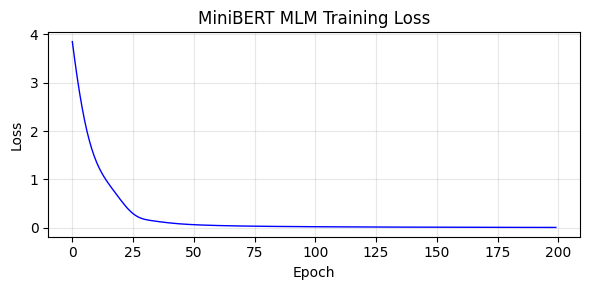
print(f"\n初始 Loss: {losses[0]:.4f} → 最终 Loss: {losses[-1]:.4f}")
=== MLM 训练数据示例 ===
MASK_ID = 3

句子 1:
  原始: [5, 8, 10, 6, 9, 4]
  输入: [5, 8, 3, 6, 9, 4]
  labels: ['ignore', 'ignore', 'MASK→10', 'ignore', 'ignore', 'ignore']

句子 2:
  原始: [5, 12, 13, 14, 4]
  输入: [5, 3, 13, 14, 4, 0]
  labels: ['ignore', 'MASK→12', 'ignore', 'ignore', 'ignore', 'ignore']

句子 3:
  原始: [7, 8, 11, 6, 15, 4]
  输入: [7, 8, 11, 3, 15, 4]
  labels: ['ignore', 'ignore', 'ignore', 'MASK→6', 'ignore', 'ignore']

句子 4:
  原始: [5, 16, 17, 18, 4]
  输入: [5, 16, 17, 3, 4, 0]
  labels: ['ignore', 'ignore', 'ignore', 'MASK→18', 'ignore', 'ignore']

句子 5:
  原始: [7, 16, 19, 20, 4]
  输入: [7, 16, 19, 3, 4, 0]
  labels: ['ignore', 'ignore', 'ignore', 'MASK→20', 'ignore', 'ignore']

句子 6:
  原始: [5, 21, 22, 9, 23, 4]
  输入: [5, 21, 3, 9, 23, 4]
  labels: ['ignore', 'ignore', 'MASK→22', 'ignore', 'ignore', 'ignore']

=== 训练 MiniBERT (MLM) ===
Epoch   0 | Loss: 3.8524
Epoch  20 | Loss: 0.5691
Epoch  40 | Loss: 0.1018
Epoch  60 | Loss: 0.0474
Epoch  80 | Loss: 0.0309
Epoch 100 | Loss: 0.0227


Epoch 120 | Loss: 0.0177
Epoch 140 | Loss: 0.0142
Epoch 160 | Loss: 0.0116
Epoch 180 | Loss: 0.0097
Epoch 199 | Loss: 0.0083

初始 Loss: 3.8524 → 最终 Loss: 0.0083
# ============================================================
# 测试:MLM 预测效果
# ============================================================
import torch
test_sentence = torch.tensor([[5, MASK_ID, 10, 6, MASK_ID, 4]])  # 我 [MASK] 猫 它 [MASK] 可爱

model.eval()
with torch.no_grad():
    logits = model(test_sentence)
    predictions = logits.argmax(dim=-1)

print("=== MLM 预测结果 ===")
print(f"输入:  {test_sentence.tolist()[0]}")
print(f"       ['我', '[MASK]', '猫', '它', '[MASK]', '可爱']")
print(f"预测:  {predictions.tolist()[0]}")
print(f"       ['我', '?', '猫', '它', '?', '可爱']")
print(f"\n位置 1 (预测) = {predictions[0, 1].item()} (期望 8='喜欢')")
print(f"位置 4 (预测) = {predictions[0, 4].item()} (期望 9='很')")

# Visualize loss
import matplotlib.pyplot as plt
plt.figure(figsize=(6, 3))
plt.plot(losses, 'b-', linewidth=1)
plt.xlabel('Epoch')
plt.ylabel('Loss')
plt.title('MiniBERT MLM Training Loss')
plt.grid(True, alpha=0.3)
plt.tight_layout()
plt.show()
=== MLM 预测结果 ===
输入:  [5, 3, 10, 6, 3, 4]
       ['我', '[MASK]', '猫', '它', '[MASK]', '可爱']
预测:  [12, 12, 10, 18, 12, 22]
       ['我', '?', '猫', '它', '?', '可爱']

位置 1 (预测) = 12 (期望 8='喜欢')
位置 4 (预测) = 12 (期望 9='很')
5. BERT 的微调范式
BERT 预训练完后,不同下游任务只需在顶层接不同的分类头。关键问题是:分类头接在哪里?
预训练好的 BERT 本体是一个「通用文本编码器」——输入一段文本,输出每个 token 的 hidden state。不同任务需要的信息位置不同:
| 任务 | 需要什么信息 | 分类头接在哪里 |
|---|---|---|
| 单句分类(情感分析) | 整句话的语义 | [CLS] 的 hidden → 分类层 |
| 句对分类(NLI、相似度) | 两句的关系 | [CLS] 的 hidden → 分类层 |
| 序列标注(NER) | 每个词的类别 | 每个 token 的 hidden → 各自的分类层 |
| 问答(SQuAD) | 答案的起止位置 | 每个 token 的 hidden → start/end 两个分类层 |
为什么单句和句对分类都取 [CLS]?因为 [CLS] 在 BERT 的输入最前面,经过多层双向 Attention 后,整句话的信息被聚合到了 [CLS] 的 hidden state 里——它是一个「整句摘要」。直接拿它过一个分类层就能做句子级别的判断。
序列标注任务(比如 NER:给「苹果发布新手机」标注为 [ORG, O, O, O])需要每个 token 各自的类别,所以不能只取 [CLS]——需要对每个位置的 hidden state 分别做分类。
核心洞察:经典 BERT fine-tuning 通常是在顶层加任务头,并让 BERT 本体和任务头一起微调;冻结 BERT 只训练头是一种省资源的选择,不是默认范式。这和 GPT 的 prompt engineering 不同:BERT 更常通过任务头和微调适配任务,GPT 更常通过 prompt / SFT / RL 等方式适配。
import torch.nn as nn
# ============================================================
# 演示:用 MiniBERT 做句子分类
# ============================================================
import torch
class MiniBERTForClassification(nn.Module):
    """在 MiniBERT 上接一个分类头"""
    def __init__(self, bert, num_classes):
        super().__init__()
        self.bert = bert
        self.classifier = nn.Linear(bert.d_model, num_classes)

    def forward(self, x):
        hidden = self.bert.encode(x)  # (B, S, D)
        cls_output = hidden[:, 0, :]  # 取 [CLS] 的输出
        return self.classifier(cls_output)  # → (B, num_classes)

# 演示
VOCAB_SIZE = 50
bert_base = MiniBERT(VOCAB_SIZE, d_model=64, num_heads=4, num_layers=2)
clf_model = MiniBERTForClassification(bert_base, num_classes=2)  # 二分类:正面/负面

test_input = torch.randint(0, VOCAB_SIZE, (1, 10))
output = clf_model(test_input)
print(f"输入 shape: {test_input.shape}")
print(f"输出 shape: {output.shape}  ← (batch=1, classes=2)")
print(f"输出 logits: {output.tolist()}")
print(f"\n这就是 BERT 做情感分析的完整流程:")
print(f"  输入句子 → BERT 编码 → 取 [CLS] → 分类层 → 正面/负面")
输入 shape: torch.Size([1, 10])
输出 shape: torch.Size([1, 2])  ← (batch=1, classes=2)
输出 logits: [[-0.058426402509212494, 0.5479098558425903]]

这就是 BERT 做情感分析的完整流程:
  输入句子 → BERT 编码 → 取 [CLS] → 分类层 → 正面/负面
6. 真实 BERT 加载演示
上面我们从零实现了 MiniBERT,理解了 Encoder-only 架构和 MLM 训练的底层机制。现在用 HuggingFace transformers 加载一个真正的 BERT 模型,看看工业级实现和我们自己实现的版本的结构对应关系。
需要关注的是:真正的 BERT 在三个维度上做了扩展——
- 规模:BERT-base 有 12 层 Transformer block、768 维 hidden size、12 个 attention head,总参数量约 110M
- 词表:用了 30,522 个 token 的 WordPiece 词表,远比我们演示用的几十个 token 大
- 预训练数据:BooksCorpus(800M 词)+ 英文 Wikipedia(2,500M 词)
但核心结构和我们实现的 MiniBERT 一致:都是 Encoder-only、都用双向 attention、都通过 MLM 预训练来学习上下文理解能力。
# ============================================================
# 用 transformers 加载真实 BERT
# ============================================================
import torch
try:
    from transformers import AutoTokenizer, AutoModel

    print("加载 BERT-base-chinese...")
    tokenizer = AutoTokenizer.from_pretrained("bert-base-chinese")
    model = AutoModel.from_pretrained("bert-base-chinese")

    print(f"BERT 参数量: {sum(p.numel() for p in model.parameters()) / 1e6:.0f}M")
    print(f"词表大小: {len(tokenizer)}")
    print()

    # 测试:看 BERT 的 attention 权重
    sentences = [
        "我爱中国",
        "今天天气真好",
    ]

    inputs = tokenizer(sentences, padding=True, return_tensors="pt")
    print(f"输入 IDs shape: {inputs['input_ids'].shape}")
    print(f"Attention mask: {inputs['attention_mask']}")
    print()

    # 前向传播
    with torch.no_grad():
        outputs = model(**inputs, output_attentions=True)

    print(f"输出 last_hidden_state shape: {outputs.last_hidden_state.shape}")
    print(f"  → (batch, seq_len, hidden_dim=768)")
    print()

    # 看最后一层的 attention(第一个 head)
    last_layer_attn = outputs.attentions[-1]  # (batch, num_heads, seq_len, seq_len)
    print(f"最后一层 attention shape: {last_layer_attn.shape}")
    print(f"  → (batch, 12 heads, seq_len, seq_len)")
    print()

    # 展示第一个句子每个 token 能看到谁
    tokens1 = tokenizer.convert_ids_to_tokens(inputs['input_ids'][0])
    print(f"句子 1 tokens: {tokens1}")
    print(f"\n每个 token 的 attention 分布(head 0):")
    for i, tok in enumerate(tokens1):
        attn_weights = last_layer_attn[0, 0, i]  # 第 0 个样本,第 0 个 head,第 i 个 position
        top2 = attn_weights.topk(2)
        print(f"  '{tok}' 最关注: ", end="")
        for j, (idx, w) in enumerate(zip(top2.indices, top2.values)):
            print(f"'{tokens1[idx]}'({w:.2f})", end="  ")
        print()

except ImportError:
    print("transformers 库未安装。运行: pip install transformers")
except Exception as e:
    print(f"加载 BERT 时出错: {e}")
    print("(这是正常的——如果网络不通或模型太大,以上面的 MiniBERT 演示为准)")
transformers 库未安装。运行: pip install transformers
7. BERT 与 GPT 对比
| BERT (Encoder-Only) | GPT (Decoder-Only) | |
|---|---|---|
| 核心任务 | 理解——「这句话什么意思?」 | 生成——「下一句该说什么?」 |
| 预训练 | MLM(遮词填空,15% mask) | 自回归(预测下一个词) |
| Attention | 双向(看整句) | 单向/因果(只看前面) |
| 输入表示 | Token + Segment + Position | Token + Position(无 Segment) |
| 输出 | 每个位置的 hidden state | 每个位置的 logits(但生成时只用最后一个) |
| 怎么用 | 加分类头微调 | 改 prompt / 对话格式 |
| 代表模型 | BERT, RoBERTa, DeBERTa | GPT-3/4, LLaMA, Qwen, DeepSeek |
| 适用场景 | 理解类任务(分类、NER、问答) | 通用生成 + 理解(聊天、写代码、推理) |
表格最下面一行把 BERT 和 GPT 分别框在了"理解"和"生成"里。2018 年的时候,这个区分是对的。但现在,GPT 系列的模型已经同时擅长理解和生成了。这就引出一个问题:为什么最终胜出的是 Decoder-Only,而不是 Encoder-Only 或 Encoder-Decoder。
答案不是一个原因,而是三个层面的优势叠加。
训练 token 利用率更高。 这是技术上最关键的差异。假设训练数据是一段 1024 个 token 的文本。Decoder-Only 用 Causal LM 目标训练,每个位置都产生训练信号:位置 0 预测位置 1 的 token,位置 1 预测位置 2,一直到位置 1022 预测位置 1023。1024 个 token 产生 1023 个训练样本。Encoder-Decoder 用 Prefix LM 目标训练,前 512 个 token 送入 encoder,后 512 个 token 由 decoder 预测。只有后 512 个 token 产生训练信号——前面的位置虽然被处理了,但不直接贡献 loss。有效训练信号减半。
在万亿 token 的训练规模下,这个差异被放大:相同计算预算下,Decoder-Only 从每个 token 中提取了更多训练信号,perplexity 下降更快。Google DeepMind 在 2024 年做了一组对照实验(从 150M 到 8B 参数,用 1.6T token 训练),直接验证了这个结论——相同计算量下,Decoder-Only 几乎主导了 compute-optimal frontier。
架构更简洁。 Decoder-Only 只有一种注意力:self-attention 加 causal mask。Encoder-Decoder 有三种:encoder 的双向 self-attention、decoder 的因果 self-attention、连接两者的 cross-attention。三种注意力意味着更多的超参数、更复杂的分布式训练通信、更容易出问题的工程实现。当模型参数量达到千亿级别时,架构每简化一步,训练和调试的难度就降低一个量级。
推理时的 KV-cache 更直观。 Decoder-Only 生成时每次只新增一个 token,历史 token 的 K 和 V 缓存在 KV-cache 里,新 token 只需要和缓存做一次 attention。Encoder-Decoder 推理时需要同时管理 encoder 输出和 decoder 的 KV-cache,内存管理更复杂。虽然 encoder 可以一次并行处理完整个 prompt(这是它的优势),但在现代推理框架(continuous batching、prefix caching 等)的优化下,这个优势被缩小了。
但 Encoder-Decoder 并非被淘汰了。 Google DeepMind 的同一组实验还发现了一个值得注意的事实:经过 instruction tuning 之后,Encoder-Decoder 的下游任务性能追上了 Decoder-Only,在部分任务上甚至更好,而且推理吞吐量显著更高。它在 pretrain 阶段的落后,很可能不是因为能力不够,而是因为 prefix LM 目标和下游评估方式之间的匹配度不如 causal LM。但行业已经为 Decoder-Only 投入了太多基础设施和生态,切换成本太高。
BERT 和 GPT 是同一篇 Transformer 论文的两种用法——一个用 Encoder 做理解,一个用 Decoder 做生成。GPT 在规模竞赛中胜出了,但 BERT 的思想没有消失:
- RoBERTa 去掉了 BERT 的 NSP 任务(发现它没用),只用 MLM,更多数据训更久,效果显著提升
- DistilBERT 通过知识蒸馏把 BERT 缩小 40%,速度提高 60%,但保持了 97% 的效果
- DeBERTa 改进了 Attention 机制(解耦相对位置和内容),一度在 SuperGLUE 上超越人类基准
- MLM 的「遮住一部分让模型猜」策略被 T5、BART 甚至现代多模态模型广泛吸收
BERT 用双向 Attention 做 MLM,擅长理解但不擅长生成。GPT 用单向 Attention 做自回归,擅长生成且随着规模增长涌现了理解能力。Decoder-Only 最终胜出不是因为它在所有维度都更强,而是因为 Causal LM 的训练效率、架构简洁性和生态惯性叠加在一起,在大规模训练这个具体场景下形成了压倒性优势。BERT 的 MLM 思想和双向编码设计至今仍影响着整个 NLP 领域。
小结
这一节所学的内容:
- Encoder-only 模型(如 BERT)使用双向 Attention,能看到完整输入序列
- BERT 的预训练任务是 MLM(遮词填空),而非自回归的"预测下一个词"
- BERT 的输入由三个 Embedding 相加:Token + Segment + Position
- 微调时在 BERT 顶部接分类头,[CLS] token 的表示用于下游任务
- Decoder-Only 胜出的三个原因:Causal LM 训练 token 利用率更高、架构更简洁、KV-cache 工程更直观
- Encoder-Decoder 经过 finetuning 后性能与 Decoder-Only 相当,且推理效率更高,但生态惯性使 Decoder-Only 成为主流
- BERT 的 MLM 思想和双向编码仍在影响 NLP 领域
作业
可以让 AI 帮忙解释思路,但不建议直接让 AI "做完这道题"。
作业 1:MLM 的 mask 比例
BERT 的 MLM 任务默认 mask 15% 的 token。这个比例不是随便选的。
小提示:想想 mask 太多或太少分别会怎样。
# 作业 1:MLM 的 mask 比例# BERT 的 MLM 默认 mask 15% 的 token。# 思考:如果 mask 比例分别是 5%、15%、50%、80%,各有什么问题?# 请将下面的 answer 替换为你的选择(填字母)answer = "在这里填你的答案"# 选项:# A) 5% 太少,模型学不到足够的填空能力;80% 太多,上下文信息严重缺失# B) 5% 和 80% 都没有问题,15% 只是一个惯例# C) mask 比例越大越好,因为模型需要更多预测练习# D) mask 比例越小越好,保留更多上下文信息assert not answer.startswith("在这里"), "请先填入你的答案"assert answer in "ABCD", "请填入 A/B/C/D 中的一个字母"correct = "A"if answer == correct: print("✅ 作业 1 通过:你理解了 mask 比例的权衡——太少学不到东西,太多上下文缺失。")else: print(f"你的答案是 {answer},再想想 mask 太多和太少各会怎样。")
作业 2:BERT 的输入表示BERT 的输入由三部分 Embedding 相加得到:Token Embedding + Segment Embedding + Position Embedding。给定一个句子对 [CLS] 猫 坐 在 垫 子 上 [SEP] 它 很 开 心 [SEP],回答以下问题:1. Segment Embedding 中,猫 和 它 的 segment id 是否相同?2. [CLS] 的 Position Embedding 对应的位置编号是多少?(从 0 开始计数)小提示:Segment Embedding 用 0 表示第一个句子,1 表示第二个句子。Position Embedding 从 0 开始编号。
# 作业 2:BERT 的输入表示# 问题 1:猫和它的 segment id 是否相同?q1_answer = "在这里填 是 或 否"# 问题 2:[CLS] 的 position id 是多少?q2_answer = -1 # 在这里填数字assert q1_answer in ("是", "否"), "请填入 '是' 或 '否'"assert isinstance(q2_answer, int) and q2_answer >= 0, "请填入一个非负整数"# 验证# 句子 1: [CLS] 猫 坐 在 垫 子 上 [SEP] → segment 0, position 0-7# 句子 2: 它 很 开 心 [SEP] → segment 1, position 8-12if q1_answer == "否": print("✅ 猫(segment 0)和它(segment 1)属于不同句子,segment id 不同。")else: print("再想想:猫在第一个句子,它在第二个句子。")if q2_answer == 0: print("✅ [CLS] 是序列的第一个 token,position id = 0。")else: print(f"[CLS] 的 position id 应该是 0,你填的是 {q2_answer}。")
作业 3:Encoder 与 Decoder 的 Attention 差异BERT(Encoder-Only)使用双向 Attention,每个 token 可以看到序列中的所有其他 token。GPT(Decoder-Only)使用因果 Attention(causal mask),每个 token 只能看到自己和之前的 token。假设输入序列是 我 爱 自 然 语 言(6 个 token),分别写出:1. BERT 中 token 语(位置 4)能 attend 到哪些位置?2. GPT 中 token 语(位置 4)能 attend 到哪些位置?小提示:BERT 的 Attention 没有 mask,GPT 的 Attention 有一个下三角 mask。
# 作业 3:Encoder 与 Decoder 的 Attention 差异# BERT 中,位置 4 的 token 能 attend 到哪些位置?# 请填入一个列表,如 [0, 1, 2, 3, 4, 5]bert_positions = "在这里填列表"# GPT 中,位置 4 的 token 能 attend 到哪些位置?gpt_positions = "在这里填列表"assert isinstance(bert_positions, list), "bert_positions 请填一个列表"assert isinstance(gpt_positions, list), "gpt_positions 请填一个列表"bert_correct = [0, 1, 2, 3, 4, 5] # 双向:能看到所有位置gpt_correct = [0, 1, 2, 3, 4] # 因果:只能看到自己及之前if set(bert_positions) == set(bert_correct): print("✅ BERT 的双向 Attention:位置 4 能看到所有 6 个位置。")else: print(f"BERT 应该能看到所有位置 {bert_correct},你填的是 {bert_positions}")if gpt_positions == gpt_correct: print("✅ GPT 的因果 Attention:位置 4 只能看到位置 0-4(自身及之前)。")else: print(f"GPT 应该只能看到 {gpt_correct},你填的是 {gpt_positions}")